The Business of Medicine
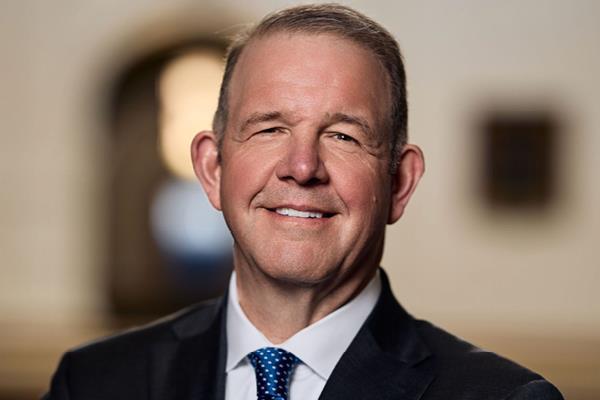
When Bradford Holland, MD, FACS, MBA ’25, decided to run for president of the Texas Medical Association (TMA), he took stock of his business training and came up with exactly one item: a macroeconomics course from 1991.
“That was the entirety of the business training that I had for that role,” Holland said.
He has been leading TMA as its president since April 2026, following a year as president-elect and four years as speaker of the House of Delegates.
Holland is also an otolaryngologist, a head and neck surgeon, a Fellow of the American College of Surgeons and an attending surgeon at Coryell Ear, Nose & Throat, with a decade of clinical faculty service in Baylor’s Department of Communication Sciences and Disorders.
He could handle the policy. He could handle the public health. What he wanted was fluency in the part of healthcare that had become, as he put it, one of the biggest challenges facing the field.
“The business of medicine was becoming certainly one of the biggest challenges to healthcare and medicine, and understanding that was really my goal,” he said. “I thought the Baylor MBA in Dallas for Executives and Professionals, specializing in Healthcare Administration, would be the best route to educate myself on that aspect I felt I was lacking. And I was right.”
Holland has no trouble naming what skills transferred immediately from the classroom to his desk. The trouble is narrowing it down. The first was health insurance, where understanding the mechanics of the industry proved extremely beneficial. The second was marketing, less obvious for a surgeon but essential for someone now leading a statewide organization of roughly 61,000 physicians and medical students. The third was accounting, from balance sheets to the flow and flux of the numbers to financial modeling.
“Three very tangible examples that I needed really right away,” he said.
The business focus never displaced the clinical one.
“I’ve always had a good appreciation for the patient side of things," he said.
What the MBA added was a view of how major institutions see the changes reshaping care.
The learning didn’t all come from the front of the room. Sitting elbow to elbow with leaders from across the delivery system gave him that view from the inside.
"It was as much learning from the professors and faculty as being in a cohort of folks representing a wide swath of healthcare and different perspectives," he said.
The people were a large part of the appeal; the professors and the classmates alike. He never wanted an online program. The value was in the room, and in Dallas the cohort met face to face.
Holland would put both the faculty and the classmates up against any other institution teaching an Executive MBA.
“These are professors who have been out in industry, but they’re outstanding teachers too," he said. “And the quality of students that Baylor attracts makes it all a top-notch program."
Holland started the program already valuing servant leadership and Christian leadership. What he hadn’t done was study them.
“We hear it a lot, but to actually study it in an academic setting and to see what that looks like and have examples, that was very meaningful to me,” he said. "That’s the kind of leadership I think we should have. And if you talk about both servant leadership as well as Christian leadership, nobody does that better than Baylor.”
Today the payoff shows up most clearly across the table from state legislators.
“The economics of healthcare are what are driving everything, and the economics are killing us right now," Holland said.
He says having an educated basis behind that argument changes the conversation, and so do the credentials that come with it.
“People really do listen more attentively and understand that perspective with a greater appreciation," he said.
Holland’s advice for anyone on the fence comes out of his own hesitation, which was the time commitment. He wasn’t sure he could give up a weekend a month on a surgeon’s schedule.
“There’s never a time when it feels exactly right," he said. “Sometimes you have to take a little bit of a launch. It’s reasonable to have those hesitations. Can you afford the time? Is it going to pay off? I had those hesitations too. I can say not only that it paid off, but I would have regretted not making that commitment, not meeting those people and not having those classes."
By the end, he didn’t want it to be over.
“They was some of the best times I have ever spent," he said. “You can’t really do much in healthcare to make a difference unless you understand the economics. And I’m very pleased to have spent time doing so.”